



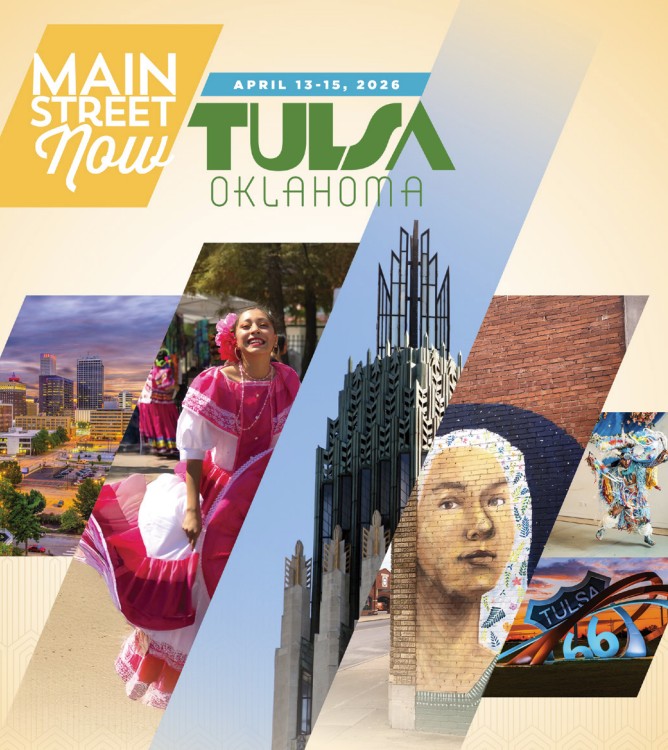
Earlier this month, the VDID team traveled to Tulsa, OK for the annual Main Street Now Conference. Thousands of professionals from hundreds of cities are part of the Main Street America network, and we gather each year to share ideas, build relationships, and learn new approaches to a shared mission: bringing America back to downtown.
There’s a tendency after events like this to come home and focus on programs—what worked elsewhere, what we can replicate, what we should try next. But this year, the strongest takeaway wasn’t a program at all. It was a reminder of what downtown is supposed to be in the first place.
Downtown is the community table where people bring their stories, their ideas, and their energy to both carry forward the legacy of a city and shape its future.
I heard someone say this at the conference and wrote it down immediately, because it reframes a lot of my thinking about development. If downtown is the table, then our role isn’t just to “activate spaces,” fill vacancies, or even put on events. It’s to make sure people feel invited to sit down in the first place.
One theme showed up again and again throughout the conference: before programs, you need trust. Before initiatives, you need relationships. Or more simply: treat belonging as an economic strategy.
That idea challenges a lot of conventional thinking in our work, where the instinct is to move quickly toward visible wins—events, promotions, new business recruitment. Those things matter, but without trust, they don’t stick. This is something I’ve been thinking about a lot lately.
In Vineland, perception often moves faster than reality. People can hold onto a version of downtown that is outdated, incomplete, or shaped more by memory than by what is actually happening today. Once that perception sets in, it quickly and quietly influences whether people choose to show up, invest, or engage. That’s where the trust gap becomes very real. How does the work we’re doing compare to the perception that already exists—and is it closing that gap?
Before momentum, before programming, before outcomes—we have to be intentional about rebuilding both trust and perception at the same time. Because in a place like downtown, perception isn’t just part of the work. It is the work. If people feel like something is being done to them instead of with them, even the best ideas will struggle to gain traction. We’ve seen that in real time. Community buy-in isn’t a bonus. It’s the foundation. What does it take for people to believe this is a place worth buying into?
Coming out of the conference, we’re narrowing our focus to find what matters most. The next phase of our work is about pulling up more chairs. If downtown is the community table, then success isn’t defined by what’s on it, but by who is sitting around it. That means building trust where it doesn’t yet exist, strengthening relationships where it does, being clearer about what we’re doing and why, and focusing our energy on work that produces results people can see and feel.
The ideas from the conference gave us a clearer lens for how to approach downtown. Through that lens, the path forward is simpler—and more demanding. We don’t need more activity, we need a realignment. And the work ahead is making sure more people have a seat at the table—and a reason to stay there. If this speaks to you we want to speak to you. Interested in a seat at the table? Send me an email at aarivera@vinelandcity.org